Our Philosophy
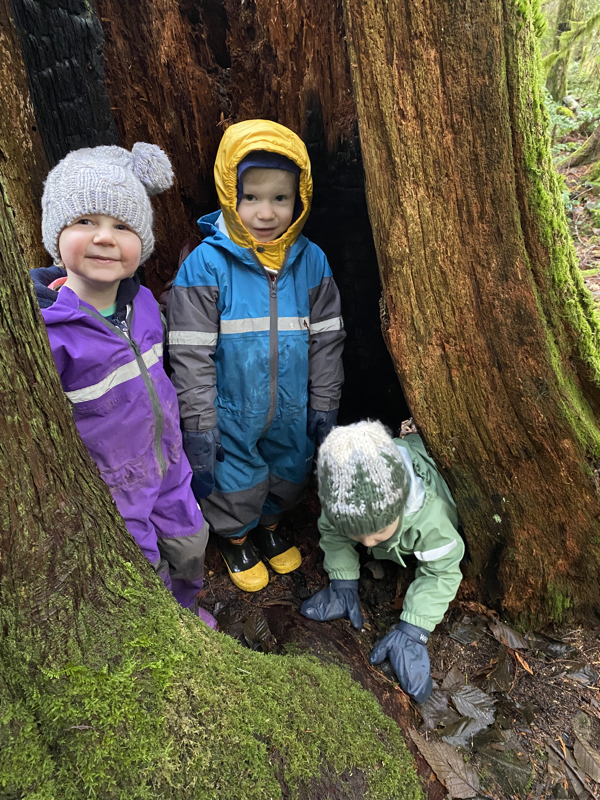
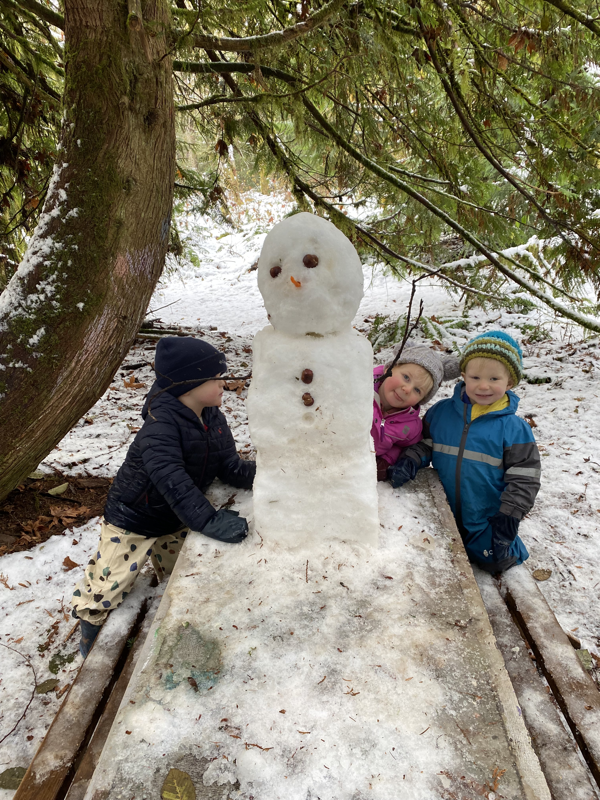
Through play and exploration, Tall Trees provides meaningful ways for children to connect with the natural world, each other, themselves and their community.
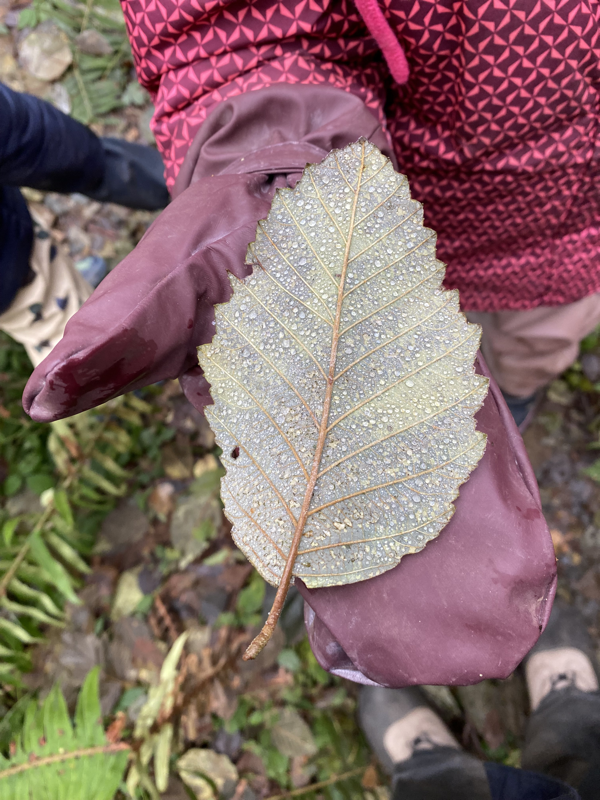
The sky is our ceiling, the trees are our walls, and the floor is the living Earth. When we consistently spend time in a natural space, we notice the fine details and changes within that place, and we develop an intimate connection to the natural world.
Tall Trees Nature Programs encourages children to engage all of their senses when in nature. We are committed to child-led learning, emergent curriculum, and an inquiry-based teaching style. Which means we allow children to follow their curiosity and interests while we help develop their social, emotional and intellectual growth. The flow of learning at Tall Trees emerges naturally with the rhythms of the changing seasons. Tall Trees Nature Programs is inspired by the Forest and Nature School model (Forest Schools Canada).
Tall Trees Nature Programs strives to promote:
- individual empowerment, self-awareness and resiliency
- co-operation, teamwork, and peaceful communication
- the development of lifelong learning skills and strategies including problem solving, risk awareness and assessment, and facing challenges in a safe and supportive environment
- understanding, compassion, and empathy for the earth and all of its inhabitants
What is Forest and Nature School?
The defining feature of Forest and Nature School inspired programs is that children are provided with opportunities to build an on-going relationship with the earth, with a dedicated educator, with one another, and with themselves.
Forest and Nature School is different from other outdoor learning experiences in two ways:
First, Forest and Nature School takes place in the same setting on a regular basis over an extended period of time. This gives students the opportunity to learn a great deal about the area and enables them to develop a lasting connection with nature.
Second, while there are some structured elements, the Forest and Nature School curriculum is largely emergent, child-directed, and play-based. The ethos of Forest and Nature School allows learners the time and space to develop their interests, skills, and understanding through practical, hands-on experiences. At Forest and Nature School, children have the freedom to explore, play, build, create, imagine, and use their senses to experience the outdoor environment and engage with one another. Sustainability is woven into the culture of the class and it becomes the foundation on which both children and teachers stand.
At Forest and Nature School, there is a strong emphasis on educators observing, learning with, and teaching students in the context of the environment. This process of observation allows children the space and opportunity to delve into various activities and experiences guided by their imagination, rather than by explicit, external direction. It also leads to a process of inquiry in which educators’ primary role is to ask a multitude of questions based on what is emerging from a student’s questions, experiences, and imagination. The guiding principle at Forest and Nature School is that children are competent and engaged learners, and with guidance and support, are able to lead their own learning process in directions far beyond what an educator can initiate on their own.
The activities that happen each day at Forest and Nature School will vary depending on the season, weather, animals that have visited the night before, branches or leaves that have blown down in the wind, the kinds of provocations elicited by the educator, various tools and loose parts available for building and creating, the children who are in attendance, how long the group has been formed, and most importantly, what interests each child. Sometimes children will work independently, finding solace in their own world and creations and ponderings. Other times children will work collaboratively to create something, problem solve, support one another, dream of a bigger and better world. Forest and Nature School can often be described as a ‘magical’ thing to witness, as it’s often a microcosm of collaboration, communication, trust building, and a working model of consensus building (Forest Schools Canada).
First, Forest and Nature School takes place in the same setting on a regular basis over an extended period of time. This gives students the opportunity to learn a great deal about the area and enables them to develop a lasting connection with nature.
Second, while there are some structured elements, the Forest and Nature School curriculum is largely emergent, child-directed, and play-based. The ethos of Forest and Nature School allows learners the time and space to develop their interests, skills, and understanding through practical, hands-on experiences. At Forest and Nature School, children have the freedom to explore, play, build, create, imagine, and use their senses to experience the outdoor environment and engage with one another. Sustainability is woven into the culture of the class and it becomes the foundation on which both children and teachers stand.
At Forest and Nature School, there is a strong emphasis on educators observing, learning with, and teaching students in the context of the environment. This process of observation allows children the space and opportunity to delve into various activities and experiences guided by their imagination, rather than by explicit, external direction. It also leads to a process of inquiry in which educators’ primary role is to ask a multitude of questions based on what is emerging from a student’s questions, experiences, and imagination. The guiding principle at Forest and Nature School is that children are competent and engaged learners, and with guidance and support, are able to lead their own learning process in directions far beyond what an educator can initiate on their own.
The activities that happen each day at Forest and Nature School will vary depending on the season, weather, animals that have visited the night before, branches or leaves that have blown down in the wind, the kinds of provocations elicited by the educator, various tools and loose parts available for building and creating, the children who are in attendance, how long the group has been formed, and most importantly, what interests each child. Sometimes children will work independently, finding solace in their own world and creations and ponderings. Other times children will work collaboratively to create something, problem solve, support one another, dream of a bigger and better world. Forest and Nature School can often be described as a ‘magical’ thing to witness, as it’s often a microcosm of collaboration, communication, trust building, and a working model of consensus building (Forest Schools Canada).
For more information on information, please see the links bellow:
The Forest and Nature School in Canada Handbook:
Principles of Child and Nature Alliance of Canada: